Published On May 3, 2012
GIVEN THEIR DRUTHERS, ABOUT 40% OF PEOPLE WOULD GO TO BED AROUND 11:30 P.M. and wake about 8:30 a.m. But some 10% would rather turn in at 3 a.m. or even later and sleep until mid-morning, according to an online survey of 125,000 people by Till Roenneberg, who heads the Centre for Chronobiology at the Institute for Medical Psychology at the Ludwig-Maximilians-Universität in Munich. And according to a study by the Northwestern University Feinberg School of Medicine, those night owls also tend to be overweight and to sleep fewer hours than those with more normal schedules. “Late sleepers” in the study consumed only 248 more calories a day—the equivalent of about three ounces of lean ground beef—than those who ate dinner at 7 p.m. and were asleep by 12:30. But the late sleepers had an average body mass index of 26 compared with 23.7 for early sleepers. For someone five feet eight inches tall, that’s the difference between weighing about 171 pounds and 156 pounds. “Our results show that the circadian system plays an important role in metabolism,” says Kathryn Reid, research assistant professor of neurology at Feinberg.
In fact, circadian rhythms, roughly corresponding to a 24-hour day (the Latin roots of circadianmean “about a day”), affect cells and biological processes throughout the body. It has long been known that all plants and animals, including humans, have internal clocks and that disruptions in sleep patterns can lead to problems. People who work the overnight shift, for example, have a greater incidence of diabetes, obesity, hypertension, cardiovascular disease and cancer than people who are awake during the day and sleep at night. But now researchers think that chronic (though less drastic) changes may also put people at risk. By catching up on e-mail correspondence at midnight or getting too little sleep during the week and trying to make up for it by rising later on weekends, people may overstress their bodies and make themselves more susceptible to illness. And those already vulnerable because of age or health problems could fare even worse if they fall out of phase with their circadian systems.
But even though we’ve known for some time that circadian rhythms have a direct impact on human health, much less has been understood about how the internal timekeepers in the brain and other organs communicate and what happens to put them out of sync. The most recent discoveries involve so-called clock genes, first identified in 1994, that ramp up and down the production of essential proteins that prepare cells to react to environmental stimuli. The liver, for example, relies on its clock genes to predict when food will be consumed so its cells will be revved up to metabolize and store nutrients. “If people eat when the liver isn’t anticipating nutrients coming into the body, it can’t regulate sugar and fat metabolism properly,” says Mitchell A. Lazar, director of the Institute for Diabetes, Obesity, and Metabolism at the Perelman School of Medicine at the University of Pennsylvania. “That dissonance can lead to extra fat in the liver and contribute to diabetes and lipid disorders.”
For now, most circadian experiments fall into two categories. In basic research with animals, scientists manipulate genetic clocks to gauge the impact on the organs. Meanwhile, human studies alter volunteers’ schedules to measure what happens when normal patterns of eating and sleeping are upended. The results of both lines of research could eventually lead to better disease treatments. For example, there’s already evidence that finding optimum times to administer chemotherapy or other treatments can make the drugs less toxic and more effective. “Because internal clocks are so enmeshed in regulating cells, they present many opportunities to therapeutically target genes important in cancer and even neurologic disease,” says Joseph Takahashi, professor of neuroscience at the University of Texas Southwestern Medical School in Dallas.
IN 1729, THE FRENCH ASTRONOMER JEAN JACQUES D’ORTOUS DE MAIRAN happened to observe that his mimosa plant maintained a rhythm of extending its feathery leaves during the day and furling them at night even when the plant was kept in total darkness, and during the centuries that followed, experiments on plants and animals confirmed the existence of circadian cycles. But it wasn’t until after World War II that scientists demonstrated that people, too, adhered to 24-hour patterns for sleeping and eating whether or not they knew what time it was. “It took a long time for science to get past our religious belief that we are different from animals and do what we do by free will,” says Roenneberg, who is president of the World Federation of Societies for Chronobiology.
One landmark series of experiments began in the early 1960s in a bunker, built into a hillside in southern Germany, that was completely shielded from light, sound, vibrations and even the earth’s electromagnetic forces to keep human subjects from discerning whether it was day or night. In studies run by the physician Jürgen Aschoff and physicist Rütger Wever, human volunteers stayed in the bunker for as long as eight weeks. Aschoff and Wever found that even in such isolation, most subjects naturally gravitated to a day of roughly 24 hours. Some subjects, however, experienced days as long as 48 hours, with 16 hours’ sleep, while their physiological rhythms maintained a 24-hour clock. “Subjects’ diaries revealed that they felt best when all of their body rhythms were in sync and closest to a 24-hour day,” says Roenneberg.
Once scientists knew people had innate circadian cycles, they hoped to determine whether a master clock controlled body rhythms—and if it did, where it might reside. A breakthrough came in 1972, when researchers destroyed a very small portion of the brain in rats, which then began eating and sleeping at irregular times. The scientists had surmised that the clock had to be located where it could get information about whether it was day or night, so they focused their search on a portion of the hypothalamus right above where the two optic nerves intersect, the area that receives information from photosensitive cells in the retina. The tiny region—with just 20,000 neurons in a brain that has some 100 billion—is called the suprachiasmatic nucleus (SCN). Subsequent research demonstrated that, based on signals from the retina that light is present or absent, the SCN keeps the body on a 24-hour day and regulates practically every function in it, explaining why many bodily functions fluctuate predictably day and night.
Crucial facts about the SCN’s role were learned almost by accident, when Martin Ralph, a psychology graduate student at the University of Oregon, received a shipment of hamsters in the late 1980s that turned out to have a genetic mutation that drastically changed their circadian rhythms. Ralph noticed the animals spinning their exercise wheels when they should have been sleeping and determined that the hamsters had an abnormally fast rhythm of a 20-hour day. In 1990, Ralph transplanted the SCNs of the mutant hamsters into normal ones, which then operated on a 20-hour day. And when he gave one of the abnormal rodents—called tau hamsters, tau referring to the period of the body clock—an SCN from a normal animal, the tau hamster developed a 24-hour rhythm.
In subsequent experiments, researchers found that as tau hamsters aged, they developed heart failure and died prematurely. But when times for food, light and darkness were adjusted to match tau hamsters’ unusual cycles, their health improved. “When the rodent was kept in an environment in synchrony with its body clock, it was perfectly healthy,” says Martin E. Young, associate professor in the division of cardiovascular diseases at the University of Alabama at Birmingham, who was not involved in the work.
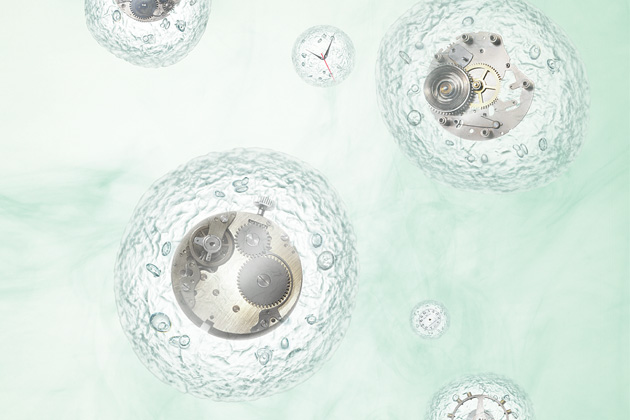
NORMALLY, THE SCN COORDINATES THE TIMING OF THOUSANDS OF ORGANS’ CLOCK GENES so that physiological processes such as metabolism are in time with such behaviors as eating and sleeping (organs’ many functions are controlled by a multitude of genes). The SCN sends signals through the nervous system to the heart, the liver and the pancreas to keep them synchronized to cycles of light and dark. It also regulates hormones and communicates with other organs indirectly by releasing hormones at various times of day.
But cells’ clock genes are also calibrated by stimuli other than light, such as feeding and temperature changes. And when people do things at unusual times, some cellular clocks may fall out of step with the central pacemaker. Eating, for example, seems to override the light-dark rhythm in controlling liver genes. “We think food intake late at night can reset clocks in the liver and pancreas, even though other clocks in the pineal and adrenal glands, which control the rhythms of melatonin and cortisol [hormones related to sleep and stress], may be ticking away based on information from the central circadian pacemaker,” says Steven A. Shea, director of the Sleep Disorders Research Program at Brigham and Women’s Hospital in Boston. When that occurs, clock genes in the liver and pancreas become uncoupled from the SCN, which isn’t reset by eating at unaccustomed times.
Animal experiments have demonstrated what happens when peripheral clocks keep their own time.Joseph Bass at Northwestern University and Takahashi eliminated the clock gene in the pancreatic islet—small clusters of pancreatic cells—of mice, which put the islet out of sync with the SCN. That clock gene regulates glucose metabolism and insulin production, and without it mice developed profound diabetes. Clocks in the pancreas and other organs appear to be only weakly coupled to the SCN, with eating as well as changes in body temperature and circulating hormones able to override signals from the SCN, Takahashi says. When rodents are given jet lag by advancing or delaying light cycles by six hours, their SCNs reset to the new schedule after a day or two, but the peripheral clocks in organ cells may take more than a week to get back in sync.
Gene clocks have a complex molecular mechanism that determines how much protein is expressed at various times. In the liver, for example, many genes are involved in lipid metabolism as the organ makes and stores its fat. Those genes rev up to produce twice the amount of proteins at peak times of lipid production, and diminish to half the baseline amount at the lowest point in the 24-hour cycle. When researchers stifle the genes, the liver continues its slow synthesis of lipids but liver fat skyrockets—even though the mice whose circadian liver genes had been shut off are fed a low-fat diet. “That dramatically demonstrates that these proteins have a circadian rhythm that presumably evolved to produce fat when the body needs it and switch off when the need is met,” Lazar says.
Interestingly, various diseases also adhere to circadian rhythms. Heart attacks, angina and death from sudden cardiac events typically happen between 6 a.m. and noon—and, according to epidemiological data, hearts are most likely to fail on a Monday morning during fall and winter, possibly because internal clocks are not prepared for an earlier wake-up time after a weekend of sleeping and eating later than normal, Young says. As light wanes during autumn and winter, internal rhythms also change. “In animals, the amplitude of proteins produced by clock genes oscillates as much as twentyfold, but when light exposure grows shorter, the amplitude drops,” Young says. This dampened response may make people more prone to adverse heart conditions when there are fewer daylight hours.
To study how circadian rhythms affect disease pathology, Young has focused on cardiomyocyte circadian clocks, located in muscle cells of the heart, during the stress of a heart attack at different times of the day. Young opens the chests of mice and loosely ties a suture around a coronary artery and feeds the ends of the suture out of the chest. Then he lets the animals recover from the surgery so their immune systems regain natural circadian rhythms. Finally, Young pulls the sutures to cut off blood to the artery and cause a heart attack. In his experiments, he repeated the 45-minute procedure at different times of day and found that the heart attacks mice suffered when they were awakening caused 3.5 times more damage than attacks induced before their sleep period.
Young then repeated the experiment in genetically altered mice whose gene clock regulating the function of cardiomyocytes—muscle fibers that cause the heart to contract—didn’t work. When Young gave these animals heart attacks, the damage was at the same minimal level regardless of time of day. “That shows how important these clocks are for influencing the outcome of heart attacks,” he says.
In another study, Young considered the synthesis of triglycerides. In people who are obese or who have diabetes, these fatty acids can accumulate in the heart and cause dysfunctional contractions. Young fed two groups of mice an identical diet but at different times of day. One group ate a high-fat breakfast at the beginning of its active period, the other a high-fat meal at the end of the active period. The mice that ate the high-fat dinner developed metabolic syndrome, gaining more weight and developing fat and insulin resistance—precursors of diabetes—and high cholesterol. The highest rate of triglyceride synthesis—which promotes storage of calories as fat—was at the end of the active period for the rodents. That could help explain why people who skip breakfast tend to weigh more—because they tend to eat more calories later in the day.
IN HIS WORK WITH HEALTHY HUMAN SUBJECTS, Steven Shea uses changes in schedule to force a desynchronization of behavior from circadian systems. Volunteers live in Shea’s lab for as long as two weeks, changing the time they go to bed and get up so they’re following either a 20-hour or a 28-hour day. For the 20-hour schedule, the volunteers typically go to bed at midnight the first day, 8 p.m. the second, 4 p.m. the third, noon the fourth and so on. By the time they’re turning in at noon, all their normal waking activities are happening during “biological night”—what would be nighttime on a normal schedule. Then Shea and his associates measure the subjects’ physiological responses to exercising, eating and sleeping, which now occur at different circadian phases than they normally would.
“We’re finding considerable differences in the magnitude of physiological responses based on circadian phases,” Shea says. For example, blood tests showed that subjects’ platelets became more likely to clot between 8 a.m. and 9 a.m. Platelet activation followed its own circadian cycle independent of when subjects slept or woke, and that timing corresponded to the vulnerable morning period when most heart attacks, strokes and sudden cardiac death occur. Platelets form blood clots, a process that goes awry in cardiovascular disease, the frequent cause of a heart attack.
AS RESEARCH LEADS TO A GREATER APPRECIATION OF THE CIRCADIAN SYSTEM’S ROLE in developing disease, scientists are considering how they might use the body’s clocks to improve clinical treatments and to minimize side effects. “It would be especially useful in the case of such chronic diseases as diabetes and obesity to reduce the toxicity of drugs that have to be taken for decades,” Lazar says. Or instead of giving people the highest dose of a drug that they can tolerate in treating a heart condition, for example, it could be better to have them take less but have the drugs arrive at just the time of day that platelets tend to aggregate, Shea says.
Physicians have known for decades that cancer chemotherapy is most effective during particular times of day, and in a mouse experiment, Takahashi and Marina Antoch of the Roswell Park Cancer Institute in Buffalo found that the agent cyclophosphamide was minimally toxic to healthy tissues when given at dusk, but that mice died if they got it at dawn. Clinical trials in Europe are attempting to optimize timing so that patients receive treatments when they’re least sensitive to toxic side effects and cancer cells are most vulnerable.
Meanwhile, after 25 years of investigating circadian rhythms, Till Roenneberg has abandoned his alarm clock, except when he has to catch an early flight. “For the past 500 million years, organisms have gone to the trouble of inventing a system in which every reaction in the cell and every communication between cells creates a harmonic biochemical orchestration,” he says. “This ancient system is not something we can override with discipline or learning. And if we do mess with it, we’ll develop more illnesses than we would normally have.”
Dossier
“The Genetics of Mammalian Circadian Order and Disorder: Implications for Physiology and Disease,” by Joseph S. Takahashi et al., Nature Reviews/Genetics, October 2008. In the future, say the authors of this review article, treatment for diabetes and obesity may include altering circadian rhythms because they are so “intimately linked” to metabolism and cell proliferation.
“Influence of the Circadian System on Disease Severity,” by Mikhail Litinski et al., Sleep Medicine Clinics, June 1, 2009. The authors present fascinating evidence not only that misaligned circadian clocks contribute to disease but also that normal fluctuations in circadian rhythms can make people with certain disorders more vulnerable to adverse events at particular times of the day.
“Role of Sleep Timing in Caloric Intake and BMI,” by Kelly G. Baron et al., Obesity Journal, April 2011. In one of the few studies that examine weight and sleeping patterns in humans, Baron and colleagues found that people who went to bed late ate more of their calories after 8 p.m. and consumed more junk food than did people who went to sleep at a more typical time. Late sleepers ate on average 248 more calories per day—which, after a month, would add two pounds to their weight.